
Hapla Group T2f1

🌿 Understanding My Maternal Haplogroup: T2f1

Exploring ancient ancestry through mtDNA

I’ve always loved science—genetics, family history, and the stories hidden in our DNA. Learning about dominant and recessive genes, Punnett squares, and blood types has always fascinated me. Recently, I’ve been diving deeper into haplogroups, and it has opened a whole new window into my maternal ancestry.

🧬 What a Maternal Haplogroup Is

A maternal (matrilineal) haplogroup is a genetic population group that traces back through your mother, your grandmother, your great‑grandmother, and so on. Because mitochondrial DNA (mtDNA) is passed down only through mothers, it allows us to follow a single, unbroken line stretching back thousands of years.

Haplogroups are labeled with letters and then refined with numbers and additional letters. They don’t tell you about recent relatives, but they do reveal where your ancient ancestors lived long before written records or surnames existed.


🌍 My Haplogroup: T2f1

Through 23andMe, I learned that my maternal haplogroup is T2f1. A few fascinating details:

  • T2f1 is considered relatively common, appearing in about 1 in 280 people.

  • The T2f1 subgroup is estimated to be around 4,000 years old.

  • The broader T2 lineage traces back roughly 19,500 years to a single maternal ancestor.

  • This haplogroup has roots in ancient Europe and the Near East.

As a woman, I can only learn my maternal haplogroup. To explore the paternal line, a male relative would need to take a Y‑DNA test—something I may look into in the future.


🧵 Maternal Surnames in My Line

These are the surnames connected to my maternal ancestry:

  • Johnson

  • Schmidt / Schmid

  • Malkusch

  • Merkle

  • Schramke

  • Lange

Each one represents another generation carrying the same mtDNA signature.
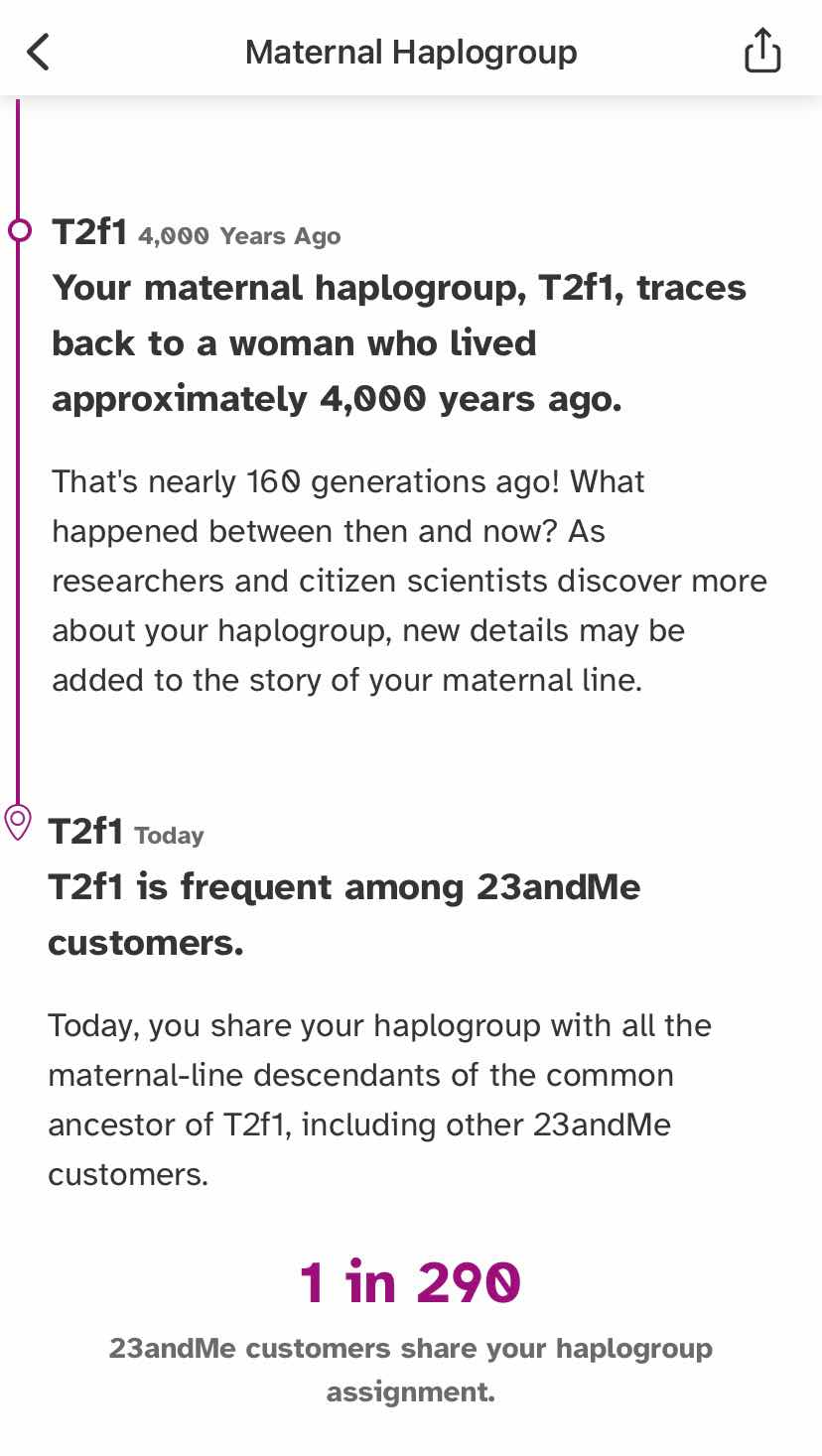


  One of the more recent things I have learned about are Hapla groups. My maternal (matrilineal) Hapla group is T2f1. A matrilineal Hapla group a genetic population group of people who share a common ancestor on the matrilineal (mothers) line. Haplogroups are assigned letters of the alphabet, and refinements consist of additional number and letter combinations. Hapla groups are just a small part of your Ancestry. We all have thousands of Ancestors going back. Haplogroups are one of the only ways to trace your family tree back to the time before surnames were invented. If you are interested in where your family originated from, before records, then haplogroups should be of interest to you. While you can’t use a haplogroup to connect to close relatives in most cases, you can use them learn more about your ancient ancestors. 

  I completed  a DNA test through 23andMe , when the results arrived it listed my maternal hapla group. Since I am a female, only the maternal side for hapla group could be found. Maybe in the future..I might have a my male member of the family complete a test to learn the paternal hapla group. According to 23andMe T2f1 is a relatively common hapla group, it matches 1 in 280 people. T2f1 haplagroup is about 4,000 years old, and traces back to a woman. The T2 Origin is about 19,500 years. It can be traced to a woman who lived nearly 20,000 years ago.

  Meternal Hapla group surnames in my family tree are: Johnson, Schmidt, schmid, Malkusch, Merkle, Schramke & Lange.

👑 Famous Individuals with Haplogroup T2

Several historical figures are believed to belong to the T2 haplogroup, including:

  • Nicholas II of Russia, the last Russian Tsar

  • Members of various European noble families

  • Jesse James, the American outlaw, whose remains matched T2 through maternal relatives

These connections don’t mean we’re closely related—just that we share a very ancient maternal ancestor.


  Nicholas II of Russia - The last Russian Tsar, Nicholas II, has been shown to be of Haplogroup T, specifically subclade T2 (Ivanov 1996). Assuming all relevant pedigrees are correct, this includes all female-line descendants of his female line ancestor Barbara of Celje (1390-1451), wife of Sigismund, Holy Roman Emperor.


  Jesse James (1847-1882), a famous American outlaw, from the US state of Missouri. He was a celebrity when he was alive, and became a legendary figure of the Wild West after his death. Jesse James's remains were compared against two maternal relatives and all were found to belong to matrilineal -haplogroup T2.


🔗 Helpful Resources

If you’re curious about your own haplogroup or want to explore deeper:


💬 Final Thoughts

Haplogroups are just one small part of our ancestry, but they offer a rare glimpse into the deep past—long before surnames, borders, or written history. Learning that I belong to T2f1 has made me feel even more connected to the generations of women who came before me.


Comments

Post a Comment

I love to hear back from my readers, please leave a message below:

Popular posts from this blog

Fidget Blanket (Fummeldecke) Ideas

This will be my first time ever making a fidget blanket- I was so happy to have the opportunity today to gift my Oma a fidget blanket. I love her with all my heart, it just makes me so sad that not much can be done for her while struggling through dementia. She told me it was beautiful and she appeared to like it. I showed her each square and what she can do with it. The first thing she noticed was the wording; „Mit Liebe Gemacht“ which translates to „Made with love“.  Oma Hildegard is German and I wanted to make sure she would recognize things and always remember that we love her.  What is a Fidget Blanket? Fidget blankets are therapeutic small lap quilts to which different kinds of things are sewn or added on. These items offer sensory stimulation that can have a calming effect on patient who struggle with memory loss. The Fidget blankets help them stay busy avoiding boredom. It provides a means of performing repetitive behaviors that are often reassuring and calming. ...

The Low Oxalate Diet

A low-oxalate diet is a diet that is low in oxalates. Oxalate is a chemical found mostly in plant foods. A low oxalate diet can help prevent future kidney stones.  The most common type of kidney stone is calcium and oxalate. The following are low oxalate foods Meat:  All fresh and frozen meats: beef, pork, chicken, turkey; fish and seafood such as flounder, salmon, tuna, shrimp, scallops; and eggs. (Avoid cured meats.) Dairy:  Dairy products made with cow’s and goat’s milk, including buttermilk, skim milk, 1% and 2% milk, whole milk; butter; all cheeses, including cheddar, feta, farmer, goat, mozzarella, Parmesan; sour cream, whipping cream, half & half; yogurt, plain, or with low oxalate fruit. Fruits:  Apples, avocados, cherries, cranberries, bananas, melons (cantaloupe, honeydew, watermelon), seedless grapes (red and green), peaches, plums. Vegetables:  Asparagus, broccoli, cauliflower, cucumbers; iceberg and Romaine lettuc...

Healthy Recipes

Cauliflower Chili Zucchini Sliders Zucchini Sliders Links: Chicken Wrap Chicken Parmesan More Recipes More Healthy Food (Free Recipes) Facebook Health Group for Women Tried & True Recipes